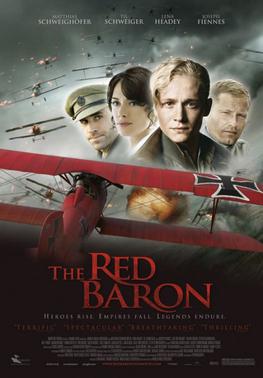
A Great War epic that is a visual smorgasbord for lovers of history. Directed by Nikolai Müllerschön. Set in France and Belguim in the year 1916, "Der Rote Baron" tells the story of Manfred Von Richthofen, Germany's most famous flying ace. The dialogue is English, however the cast is German, such as actor Tomáš Koutník who portrays the Baron. The film was made in English to make it more marketable to foreign audiences, but resulted in a box office flop at home, as well as abroad.
THE GOOD
What I first noticed about this film was its color. The war was not always drab, dull and colorless. The colorful uniforms of the officers are shown off spectacularly, as well as the dazzling and confusing array of insignia and subtle indications of rank. If you are not well versed in German/Prussian rank denotations (which I am not), then expect to only understand the pecking order by who calls whom "sir."
The film captures the Prussian/German attitude and personality very well: confident and calculating. They stand up straight and get to the point quickly when on business but are very personable and loose behind closed doors with friends. It is also noticeable that ethnic Germans/Prussians, etc, are wearing their wedding bands on the correct hand (the right), a factor often overlooked and therefore portrayed incorrectly.
The attitude of the pilots is also well represented. Cocky, brave, and confident. They were the celebrities of their day, and they knew it. To many, it was a life of glamor, sport, and competition...if you survived combat and got over the moments of sheer terror. Pilots of both sides both revered and hated each other. (An honorable mention to the portrayal of a German Jewish pilot, one of many in ww1)
Another good point is that the film accurately shows the confusion of aerial combat. Flips and turns and spins that almost make your heart shoot into your throat just by watching them. The Luftstreitkräfte insignia on the planes are correct for the time, as well as a good view of the rotary engines that are in use which shows a lot of thought going into the design. The pilots are also shown with the wind whipping past them and the heavy clothing that was a necessity.
The color facings on the caps reflected the regiment that the wearer originally came from. Manfred's is red because he originated from the 1st Uhlans whose facing color was poppy red, while his brother (who appears later in the film) from the 4th Dragoons whose facing color was lemon yellow. The cap cockades are also correct: The top being red, white and black for Germany, and the bottom being the appropriate color for the region. In this case, black. white, black for Prussia.
THE BAD
Of course, there has to be a love story thrown in somewhere, or else nobody would watch it. It really slows down the story for a while as most movie romances do.
The people, his relations, his quotes, are largely fictionalized. However, this is a movie, not a documentary.
The middle of the film is quite slow, with overall dialogue that is a bit bland. However, keep in mind that this was made for money and national pride, not exactly for finicky historians.
THE UGLY
The Red Baron is shown as a bit of a pacifist and over gentlemanly. In once scene, he instructs his men to shoot the aircraft, not the pilot. In reality, it was exactly the opposite. He told his men: "Aim for the man and don't miss him. If you are fighting a two-seater, get the observer first; until you have silenced the gun, don't bother."
A Handley Page bomber shot down in one scene has a Royal Mail logo painted on the fuselage. The Royal Mail didn't exist at this time, it would have been the GPO.
When Richtofen fought Lanoe Hawker, Hawker was flying an Airco DH.2 'pusher' style fighter. Not an SE5. Also the "Grim Reaper" painted on the side of his aircraft in the movie was in real life painted on the aircraft of the French Escadrille N.94, not Hawker's.
A major plot point involves Werner Voss installing a Bentley engine in his Fokker Dr.1 Triplane. Later Anthony Fokker complains about German pilots using Allied engines. In reality the Fokker Dr.1 was powered by the Oberursel Ur II 9-cylinder rotary engine, an unlicensed bolt-for-bolt copy of the Le Rhône 9J engine used by such Allied fighters as the Nieuport 17 and the Sopwith Camel, therefore Anthony Fokker had no grounds to complain about Allied engines powering his fighter.
THE SENTENCING
Historical accuracy = 8/10
Overall experience 8/10
The Germans have always been known for well researched and accurate films, and this is no exception. The only thing that took away from the film was a bit of weak dialogue that was forced in to suit an audience that wasn't interested in a true to life documentary film. The movie is pretty historically sound (love story aside), with the REAL inaccuracies being so small that you have to really try to find them. Lots of action, a good selection of actors, and a visual feast. I would not mind owning this film JUST for the set, costume, and prop design.
Sources
McAllister, Hayden, ed. , p.61, Flying Stories. London: Octopus Books, 1982. ISBN 07064017348
Pusher Aces of World War 1. p. 22.
http://www.theaerodrome.com/forum/other-wwi-aviation/44817-german-wwi-pilots-brim-hat-colors.html
http://www.landships.freeservers.com/jpegs/german_unif_DF_plate4.JPG
Outside undocumented/unlisted but researched and proven sources
http://www.theaerodrome.com/forum/2001/12086-jewish-aviators.html

No comments:
Post a Comment